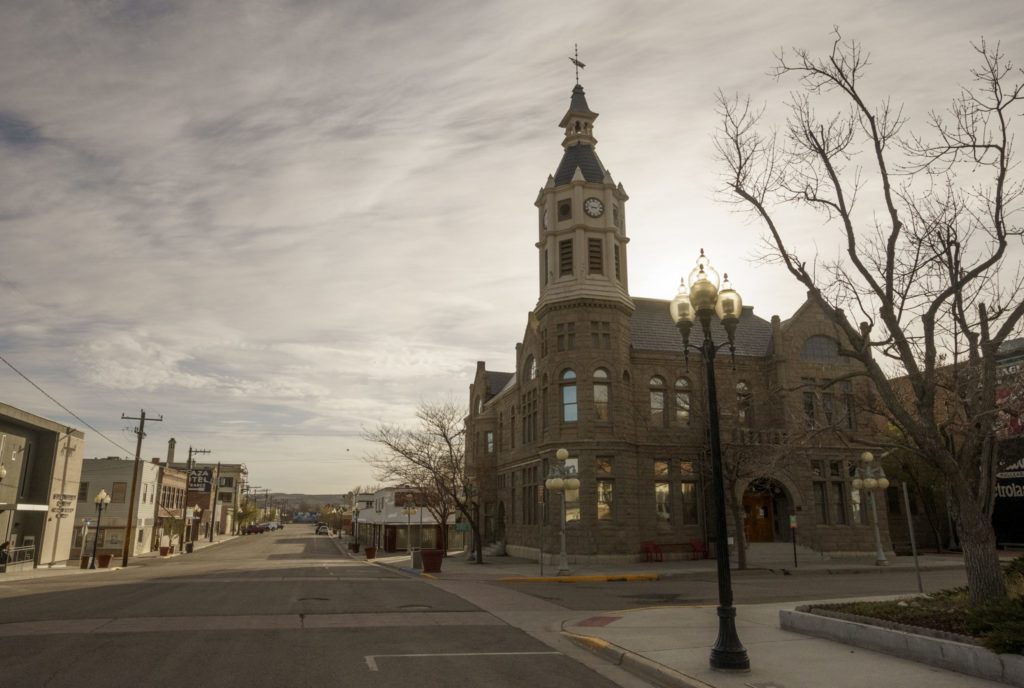

ROCK SPRINGS — The building that now houses the Rock Springs Historical Museum once served as the working center of city public safety and justice, with police, firefighters, a municipal court, and a jail under one roof.
Museum director Jennifer Messer said it also held a future vice president for a time.
Messer told guests on the Rock Springs Chamber of Commerce historic downtown bus tour that the jail was in use until about 1984, when city operations then moved to a new building across the street.
Wearing Different Hats
Messer said the building housed both the police and fire departments. Municipal court was held in the building, with the judges’ chambers just behind the museum’s second-floor gathering area.
When Messer started at the museum about 10 years ago, some officers still on the force had worked out of the building. Retired officers and firefighters still stop by with stories, and she described them as having “oodles” of information. Former inmates visit too.
One man from Nebraska told her he and a friend, then 12 and 13, stole a car and made it to Rock Springs before being caught. They were held in the jail until adults came for them. The man could not recall which cell was his and hoped an in-person visit would jog his memory; Messer said it sadly did not.
At least two couples have been married in the jail, and one divorced woman held a trash-the-dress photo shoot in a cell.
The aging building is starting to show its age. Messer said the stairs are steep, an elevator is available for visitors who cannot climb them, and odd noises are common. When she recently changed a light bulb above the second-floor gathering area, it shattered soon after and sent glass across the floor. A new employee fresh out of high school took it in stride, despite the haunting thoughts of spirits causing the commotion.
The Cheney Connection
When former Vice President Dick Cheney spent a night in the jail in July 1963 sleeping off a hangover after a drunk driving arrest, he became one of the most famous inmates in its history.
The museum has no exhibit on it, she said. The only account she has seen is in Cheney’s autobiography, in which he writes about being in Rock Springs, where he was picked up for drunk driving. He describes the arrest as life-changing, with his wife threatening to leave him.
Messer said that, as far as she has heard, the police department paperwork connected to the arrest has disappeared.
“Everybody’s kind of cagey about it,” she said. She did not say who told her the records are missing or whether anyone has formally searched for them.
Messer also recalled a visit by Liz Cheney, the former congresswoman and Cheney’s daughter, when she was still in office. According to Messer, a meet-the-press-style news interview was staged from the balcony at the fire station, with cameras, makeup artists and Republican Party members on hand. Messer said someone in the crowd asked Liz Cheney about her father’s arrest. Messer said Liz Cheney acted as though she had not heard the question and moved on.
Odd Advertising Keepsakes
A section of the museum’s second floor is devoted to local business history, and Messer said the donated items there are among her favorites. When the museum was set up, staff weren’t sure what to do with the awkward space at the top of the stairs. They settled on a business exhibit, with historic and current photographs of Rock Springs buildings lining the stairway.
Messer said she is most drawn to giveaways that have little to do with the business that handed them out. They include a small case shaped like a gun that turned out to be a key holder distributed by Desert Oil, a bowling alley packet that held a plastic rain bonnet, and miniature grenade-shaped pepper and salt shakers from a sporting goods store.
She also showcased wooden matches in a gold case from a funeral home, and a hand fan from a different funeral home.
Messer said the museum is always looking for historic photographs, particularly of homes and businesses in parts of town where it has little documentation.