
ROCK SPRINGS — A local legislator attempted to dispel some of the myths circulating around an upcoming ballot initiative that would reduce residential property taxes by 50% during the Rock Springs City Council meeting Tuesday night.
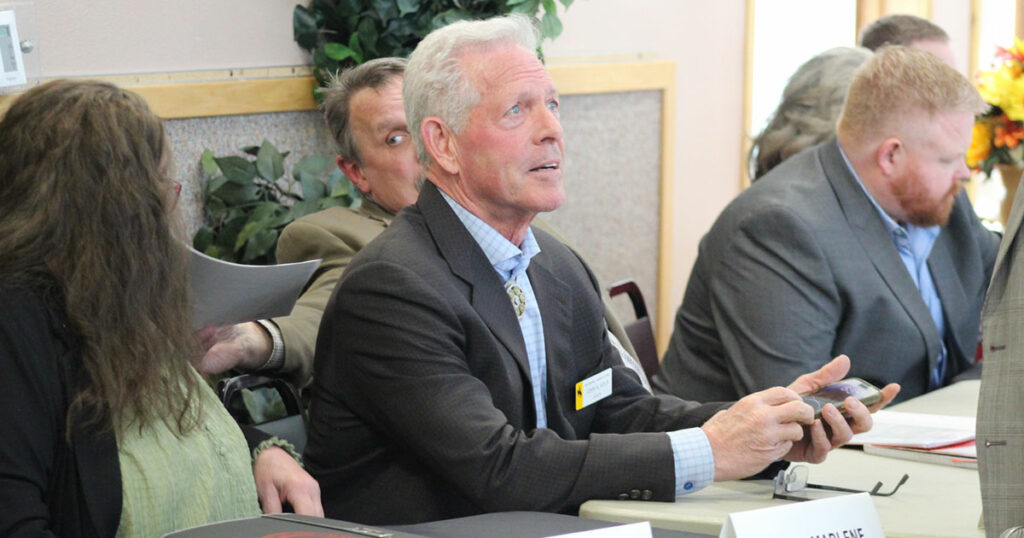
Sen. John Kolb, R-Rock Springs, was asked by Councilman Rick Milonas about the state’s investments and the state’s Permanent Mineral Trust Fund, asking Kolb why he has “a problem with backfilling.” The question comes as proponents of an initiative to reduce private property taxes argue the state has more than enough money to cover the shortfalls that would come from reductions in revenue governing bodies and special districts would see from such a cut.
“It’s pretty simple because the prop, as stated on the ballot, doesn’t even contemplate that possibility, number one,” Kolb said. “More importantly, about the PMTF, the Permanent Mineral Trust Fund that you’re referring to, we derive more than 30% of the state’s revenue from that fund.”
Kolb shared the history of the fund, saying it came from taxes on the minerals industry and does not come from property taxes. He said the fund was designed at a point when the state was broke. He said the reason for the account was to build up enough interest to run the state when the minerals industry collapses.
“It is a fund that’s for the future,” Kolb said.
Kolb further said the funds are not “the people’s money,” saying it belongs to the corporations that paid into the fund and called statements about a redistribution of wealth from a different source not true.
“This is an endowment we’re talking about. This is not some jackpot. If we disseminated that jackpot … what in the heck are we going to do? You realize that puts us over 30% short in our state’s budget,” Kolb said.
Kolb said using the fund for something beyond what it was intended for would ultimately drain the fund and not allow the state to have a tool to mitigate the volatile economic swings in the mineral extraction industries. Kolb said if the proposal appearing on the ballot were better thought out, it would identify exactly how the state would backfill funding that would be reduced.
“No, they didn’t do that,” Kolb said.
Kolb was critical of arguments made by the initiative’s supporters, saying they changed from the state having money for the future to complaints about cities and counties having too much money. He said the figures being used to talk about what counties have are incorrect, saying he doesn’t know where they come from.
This is an endowment we’re talking about. This is not some jackpot. If we disseminated that jackpot … what in the heck are we going to do? You realize that puts us over 30% short in our state’s budget?
Sen. John Kolb, R-Rock Springs
Kolb believes cities could survive the proposition passing, but admits services would be damaged as a result. While the cities would survive, Kolb believes the special districts, such as Sweetwater County Fire District No. 1 and Castle Rock Hospital District. Speaking specifically about the fire district, Kolb openly asked how the district would carry on after recently building a new fire station.
“They have fixed costs. Now you’re going to whack them half of what they’re getting – those are the ones who can’t survive this,” Kolb said.
Kolb said he’s an elected official and if voters want to navigate the state down that route, then that will be his “marching orders” and will deal with what residents voted for.
Mayor Max Mickelson followed up on Kolb’s thoughts, agreeing with points Kolb made while responding to Milonas, who is running to replace Mickelson in the General Election.
“I do not understand the approach that we, as the current generation, have the right to deprive future generations of that benefit,” Mickelson said.
Pointing to a group of Boy Scouts in the audience, Mickelson said young residents like them are the current generation’s responsibility.
“I absolutely agree with you that robbing the Permanent Mineral Trust Fund is maybe going to make things immediately easier, but would deprive future generations of the opportunities we’re benefiting from because of those past generations,” Mickelson said.