
[This article and the accompanying photos are courtesy of Craig Thomas, archaeologist and paleontology coordinator with the Bureau of Land Management’s Rock Springs Field Office]
Last fall, a routine day of rockhounding on Bureau of Land Management–managed public land in southwest Wyoming turned into an extraordinary discovery. While exploring public lands overseen by the BLM Wyoming Rock Springs Field Office, 11-year-old Touren Pope spotted what would later be identified as a fossilized turtle dating back nearly 48 million years.
Around that time, the Greater Green River Basin in southwest Wyoming looked very different than it does today. The basin had a much warmer, almost tropical climate which was dominated by a large floodplain filled with rivers and streams surrounding the remnants of the once-mighty ancient Lake Gosiute. The area supported an abundance of plant and animal life, including various mammals, fish, crocodiles, and turtles.
This story begins with an individual turtle that lived and died during this period. The turtle was of the soft-shelled variety belonging to the trionychid family. Following the turtle’s demise, its remains were buried and eventually fossilized through various natural processes. For millions of years, the fossilized turtle remained buried underground until it was recently exposed at the surface by natural erosion and weathering.
While the fossil’s emergence could easily have gone unnoticed, it was instead discovered by 11-year-old Touren while rockhounding with his grandparents, Patti and Tom Patterson. After noticing the fossil, he reported his discovery to the Bureau of Land Management. Word of the find was soon shared with paleontology staff at the Rock Springs Field Office (RSFO).
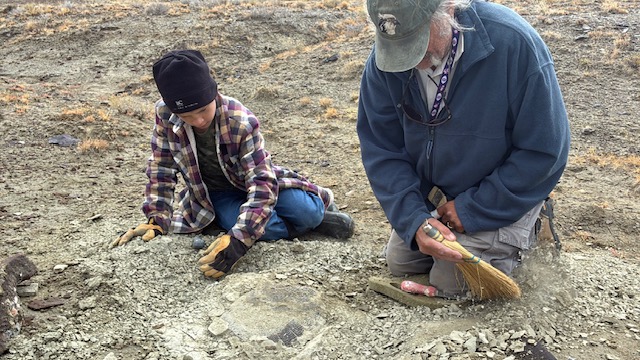
Following this news, Touren’s grandparents escorted RSFO paleontology staff to the site so the turtle fossil could be fully documented and stabilized. Once staff confirmed the fossil was located on BLM-managed land, efforts began to identify a permitted paleontologist to collect the specimen before further erosion could occur.
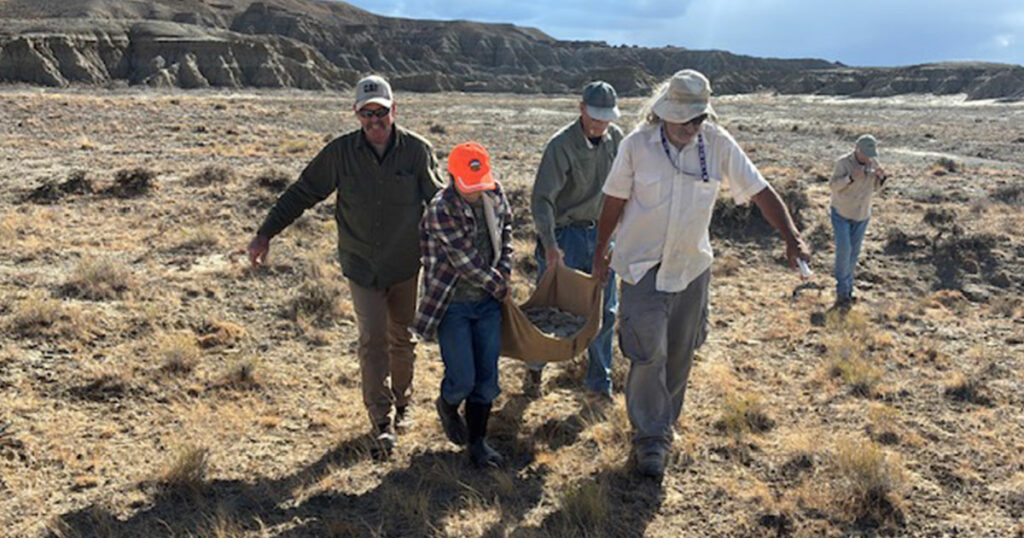
J.P. Cavigelli, museum collections specialist at the Tate Geological Museum at Casper College volunteered to help with the collection of this unique specimen. In September 2025, Cavigelli and his crew returned to the site along with Touren and his grandparents to fully excavate the fossil. The excavation revealed that only the turtle’s shell, or carapace, remained; however, it was nearly complete and well preserved.
After excavation, the fossil was transported to the Tate Geological Museum, a BLM-approved repository, where it will be cleaned and prepared for future research and possibly for public display.
This discovery would not have been possible without Touren’s keen observation for fossils and his decision to report the fossil to the BLM. By reporting the fossil, he was rewarded with an opportunity to take part in the excavation process.
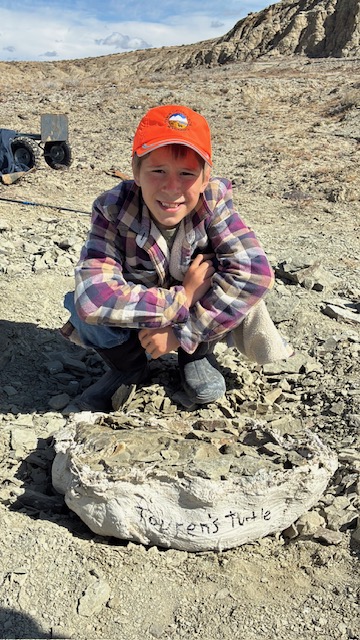
His discovery not only helped preserve an important piece of Wyoming’s paleontological history but also highlighted the role the public plays in protecting and responsibly reporting scientific resources found on public lands. Touren was also given permission to name the fossil. Henceforth, it will forever be known as “Little Timmy,” the turtle.