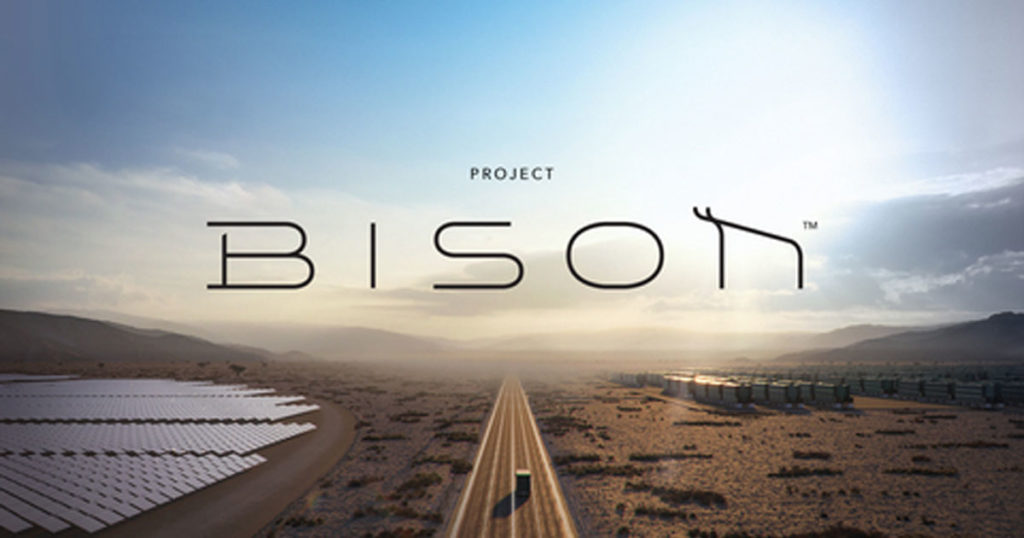

ROCK SPRINGS — A Los Angeles-based company that specializes in direct air capture (DAC) of carbon dioxide laid the groundwork for a Wyoming project that aims to store 5,000,000 tons of atmospheric CO2 annually by 2030.
CarbonCapture Inc. (CCI) met the public this week during a town hall event at Western Wyoming Community College to discuss its plans for what one company spokesperson called “the largest project” of its kind in the world.
Company Vice President of Business Development Patricia Loria said Project Bison and other DAC projects across the country could become a huge economic driver in the United States.
“We think the carbon removal industry could be as big as the oil and gas industry by 2050,” Loria said. “and why not have the state of Wyoming and the United States be leaders in those business opportunities.”
Loria told the gathering that the company is still “very much in start-up mode” and working to procure more funding for the project. CCI has raised about $43 million so far, she said.
Loria compared Project Bison to a power plant. She said once the project gets off the ground Wyomingites can expect it to be around and a steady employer for decades to come.
“We want to build those connections now so that you do see us as the best place to work in the area. That’s certainly one of our goals,” she added.
Loria said the company doesn’t “want to hurt anyone,” so a simultaneous goal will be to find land that has been disturbed or otherwise has no other uses from a sustainability perspective.
CCI has pledged not to build the project on grazing or ranchlands, migratory pathways or recreational areas. Loria called the company’s footprint over the first year of operation “pretty tiny” but it will get more complicated as the project grows.
“But we believe that in collaboration with the community, with the state of Wyoming, we can continue to find ways to grow,” Loria said. “We do think this is absolutely necessary to stabilize 1.5° global warming.”
She added that the world will need thousands of these projects to reach the goal of taking 10 billion tons of atmospheric CO2 from the air annually as recommended by the Intergovernmental Panel on Climate Change (IPCC).
How it Works
Energy Programs Manager Justin Loyka with the Wyoming Chapter of the Nature Conservancy (TNC) in Lander said the business model is to sell carbon removal “credits” to corporations interested in removing CO2 from the atmosphere.
Loyka said TNC’s goal is not to eliminate fossil fuel extraction in Wyoming but to create net negative emissions. He said Wyoming is well positioned to take advantage of a market that is already globally accepted. Loyka cited Wyoming’s long history of oil and gas production and its ongoing efforts to address carbon capture as drivers for Project Bison to be successful here.
“TNC wants to see Wyoming build a state economy that is both thriving and decarbonized,” Loyka said. “That’s the goal the governor has set and state agencies are moving toward. TNC is trying to support them in that goal.”
Carbon is captured and stored underground in sedimentary basins and later used to extract remnants of oil from wells no longer producing at a high volume, said J Fred McLaughlin, Director of the Center for Economic Geology Research in the School of Energy Resources at the University of Wyoming.
McLaughlin compared it to cleaning up motor oil off a garage floor after it’s been stained over time. The captured CO2 can be stored permanently or used for producing low-carbon synthetic fuels.
Loyka also said Wyoming has an advantage because the Department of Environmental Quality can permit these wells so the state can avoid rigorous and time-consuming Environmental Protection Agency permitting.
Wyoming’s junior college’s are also set up to provide training for these positions, and Loria estimated that Project Bison could create more than 200 permanent jobs in the state through construction and maintenance of the site.