
LARAMIE — The work of Jeff Clune and his collaborators in the field of robotics has long been respected among their peers, but now it has garnered the attention of the world’s largest science and technology magazine.
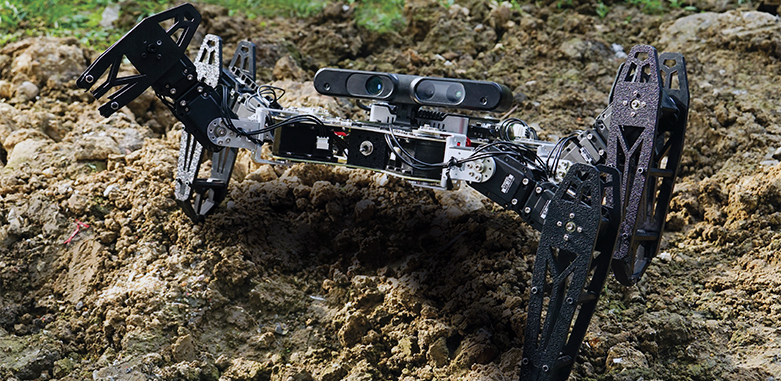
Clune, a University of Wyoming assistant professor in computer science in UW’s College of Engineering and Applied Science, was part of a team of researchers to develop self-recovering robots for use in situations too dangerous for humans. The team programmed robots to adapt to an “injury,” meaning the robots quickly learn to move in spite of damaged limbs. In less than two minutes, a six-legged creature could learn to compensate for two broken legs. Using the same technique, the researchers also created a robotic arm that could continue to move objects in spite of multiple malfunctioning motors.
The breakthrough has earned the team in which Clune participated a 2015Popular Science “Best of What’s New” Award in the engineering category.
Clune already has received attention for his research on adaptable robots. His work earned him a CAREER award from the National Science Foundation, which is a prestigious research grant for over half a million dollars that began in September and runs through 2020.
“The Best of What’s New awards honor the innovations that surprise and amaze us—those that challenge our view of what’s possible in the future,” editor-in-chief of Popular Science Cliff Ransom says. “The award is Popular Science’s top prize, and the 100 winners—chosen from among thousands of nominees—are each a revolution in their respective fields.”
The winners, the Best of What’s New, are awarded inclusion in the much-anticipated December issue of Popular Science, the most widely read issue of the year since the debut of Best of What’s New in 1988. Founded in 1872, Popular Scienceis the world’s largest science and technology magazine; with a circulation of 1.3 million and 6.8 million monthly readers.