
ROCK SPRINGS — Progress is being made with student proficiency scores in Sweetwater County School District No. 1, though a lot of work remains.
The district’s board of trustees heard a presentation about the recently-released WY-TOPP scores, which showed the district as having the third highest growth in English language arts across the state amongst the large school districts. The district also had the highest growth among large districts in science. However, the district hasn’t had positive outcomes in all subjects measured by WY-TOPP.
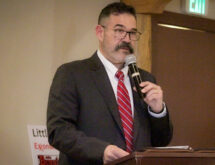
“In math, we have some work to do,” Superintendent Joseph Libby said to the school board.
Regardless, Libby said the district is excited because the test scores are about growth. He said this is the first time the district has had this type of growth “for a really long time.”
“So, we’re really excited that some of the work and some of the things we’ve put into place are really getting folks to head in the right direction around our support and services for our students,” Libby said.
At an overhead glance, little has changed as far as the individual ratings from the 23-24 results and the 24-25 results. Farson-Eden Elementary, which was partially meeting expectations in the 23-24 rating, is now listed as meeting expectations. Farson-Eden High School, which was listed as exceeding state expectations in 23-24, has declined to meeting expectations in 24-25.
So, we’re really excited that some of the work and some of the things we’ve put into place are really getting folks to head in the right direction around our support and services for our students.
Joseph Libby, Superintendent of Sweetwater County School District No. 1
The district continues seeing many of its schools listed as not meeting expectations. That list consists of every Rock Springs elementary school and Rock Springs High School. Rock Springs Junior High School and Desert School are listed as partially meeting expectations, remaining consistent with the prior year. Desert Middle School has stayed consistent in meeting expectations, while Black Butte High School and Farson-Eden Middle School continue to exceed state expectations. Libby says that there are some things to consider with some of those proficiency measures.
“Remember … our K-threes do not get a stand alone score,” he said. “The K-three gets the score of the four-six building for which they feed into.”
Libby said the district could have a kindergarten through third-grade building doing exceptionally well, but that exceptional building will get the same score as the struggling fourth through sixth building. Libby said there are seven elementary school scores tied to two buildings. Chief Academic Officer Jodie Garner said if the five Rock Springs elementary schools were individually scored, they would have scored as partially meeting expectations.
For English language arts, Libby called attention to the ninth grade percentage of students being proficient or higher, citing the 23-24 percentage 43.17 percent versus the 24-25 percentage of 52.43. Additionally, 10th grade increased from 29.53 percent to 40.06 percent, while the third grade also saw a large increase from 42.78 percent to 50.87 percent. However, Libby also said there were scores in fourth, fifth, and sixth grade that didn’t see the growth the district hoped for. Fourth grade declined slightly, with 37.88 percent in 23-24 versus 37.53 percent, while fifth grade nearly increased by a percentage point from 39.68 percent to 40.40 percent. Sixth grade saw a decline of more than two percentage points from 47.79 percent to 45.28 percent.
The growth seen in English language arts represented some of the largest gains seen across the state. Libby said the district’s goal in five years is to be 20 percentage points higher than the state average.
“This is the goal, we’re reaching for it,” he said. “The growth we’re showing right now is the growth we need to continue making for the next four years.
Libby said if the district continues on the same trajectory for those grades, they will achieve that goal.
In math, the scores show improvement in the third, fourth, and fifth grades, but see a decline in the number of students with either proficiency or advanced proficiency starting in the sixth grade and continuing to the 10th grade.
“When we hit that junior high-early high school, our math scores drop. They drop significantly across the board,” Libby said.
Libby said the biggest issue the district had to focus on was English language arts because if a student can’t read the test, they can’t comprehend the test and they can’t answer the question. While there were a lot of resources readily available for English language arts, Libby said the district didn’t have those same resources in math. This year, the district has those math-based resources, which were purchased through grant funding. Garner said the district is excited to be able to find math learning gaps and address them.
There’s some work to do in math and we know it, we’ve had conversations at our leadership team meetings with principals … we’ve got the ball rolling in two spaces, we got to get the ball rolling in the next.
Joseph Libby, Superintendent of Sweetwater County School District No. 1
Science scores are a bit different as only three grades are tested in science. Science scores saw increases across the fourth, eighth, and 10th grades. Tenth grade students saw the highest growth, from 30.95 percent at proficient or advanced proficiency to 45.33 percent. Fourth grade students also had growth from 35.42 percent to 41.71 percent, while eighth graders grew from 46.15 percent to 47.56 percent.
“It’s nice to see that we’re seeing a significant amount of growth straight across the school district, where we were number one in the state,” Libby said. “All; the skills and skill sets we’re trying to mold and put together really showed up here in our science department and the tremendous amount of work they had done.”
Overall, Libby said the district did well in English language arts and in science, but said the district’s work isn’t finished.
“There’s some work to do in math and we know it, we’ve had conversations at our leadership team meetings with principals … we’ve got the ball rolling in two spaces, we got to get the ball rolling in the next,” Libby said. “There are no excuses, we can do better. We’re going to get there.”