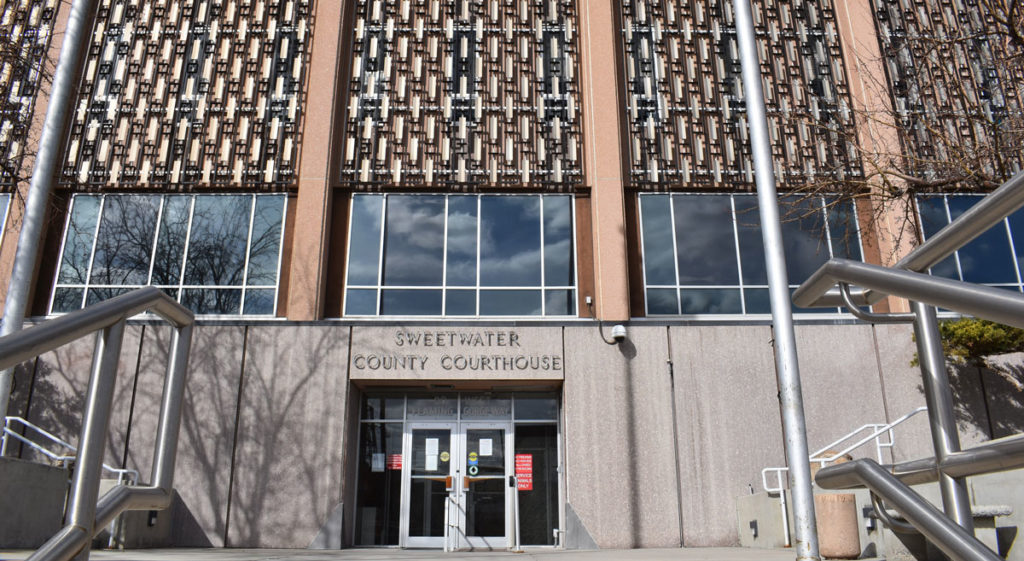

SWEETWATER COUNTY – An application to change the zoning of land along 191 near the Sweetwater County Justice Center drew concerns from residents during the Sweetwater County commissioners meeting Tuesday morning.
Brian Marincic of One9TOne, LLC requested a zone charge impacting 81.41 acres of land northeast of the justice center from I-2 Heavy Industrial to R-3 High Density Residential zoning.
Marincic submitted a sketch plat of what he’s naming the Wilkins Peak Subdivision. The proposed subdivision development will be divided into seven phases and consist of between 233 and 269 lots with both single-family housing and townhomes. According to meeting documents, Marincic believes the zone change would better serve the community as it would help create affordable rental housing.
The county’s land use staff recommend the approval of the zoning change, with the county’s planning and zoning board voting to approve the change. Megann Toomer, the county’s GIS specialist and planner, said the land will revert back to the I-2 zoning if construction on the subdivision doesn’t begin within three years. She also said the 2015 Zoning Resolution the county uses states R-3 zones should be applied judiciously where infrastructure exists, but notes the land in question has water and sewer infrastructure that isn’t servicing the property directly.
Prior to voting, Board Chairman Keaton West voiced concerns about noise coming from the nearby U.S. 191. Toomer said some mitigation could be done to lessen noise from nearby vehicles.
“It’s definitely something that can be looked into. I’ll be honest, it hasn’t been much of a discussion at this current point in time,” she said.
Commissioner Robb Slaughter said the location isn’t a logical choice for a residential subdivision, but admits it isn’t his position to judge what a developer’s plans are and where they want to build. Slaughter admits Marincic’s plan will help address the coming housing needs within the county and is pleased to see someone working to meet those needs.
During the following public hearing, Clearview Acres resident Lee Splett and Rick Marshall, the owner of Marshall’s Truck Repair, voiced concerns about the proposal.
Marshall asked the income level being targeted by the developers, saying his concern is the Sweetwater County Detention Center releases inmates daily, who then walk along the highway
“Those people over there in that housing development are going to have a higher crime rate because of this,” Marshall said. “We have a higher crime rate because of this.”
Marshall said if the development aims for lower-income residents, the crime rate in the area will increase. A second concern Marshall has is if the land across from this business is zoned for R-3, the value of his I-2 property will decrease, saying he can’t afford to lose that value. Because the county doesn’t have enforceable building codes, Marshall said the developer can also build anything they want.
Toomer said the county can enforce codes related to fire, but because the county doesn’t participate in building code, the county can’t tell a developer they have to use rebar in concrete foundations or other construction guidelines, saying they can’t tell someone how to construct a house. She said there is some control about what kinds of construction takes place, but said there could be problems because the county doesn’t have building codes.
“I know there’s been topics of conversation to add building codes to our regulations that have not been well received in the past,” Toomer said.
Splett said a proposed subdivision that would add 165 homes near the Clearview Acres area was scrapped because the City of Rock Springs, which provides water to Clearview Acres, was unable to fulfill the additional water needed by the developer. Splett said he mentions this situation because it highlights a problem with providing infrastructure in the county.
“As we develop our county and we get more and more scattered, it costs more and more to provide the infrastructure, the services, the roads … and as we go through with this; this isn’t just a burden on the developer,” he said.
Using water as an example, Splett fears an additional water line going to a subdivision within the county could cost all water users because of the added costs of waterline development on the Joint Powers Water Board. Splett urges caution while reviewing development proposals and asks that the cost of infrastructure be included in that consideration.
Speaking of Marshall’s concern about increased crime, Splett said his wife worked at Cruel Jack’s and the truck stop did have higher instances of crime because of released inmates walking from the detention center.
Marincic said this is his third attempt at getting a subdivision development going, saying the land is close enough to infrastructure to make it work. He also said the neighboring zoning on the north and south is the Bureau of Land Management and doesn’t think development will occur on those parcels of land. He also said the highway creates a buffer zone between the proposed subdivision and the I-2 land west of it. He said the road isn’t well traveled in the winter and much of the truck traffic is going to the nearby landfill.
“At the end of the day, it’s hard and this piece works,” Marincic said. “All of the pieces are close enough for it to work.”
Prior to the commissioners’ vote, Island Richards commented that it was interesting to see a NIMBY (Not In My Back Yard) being used by someone operating a commercial business and not wanting a residential development nearby, saying it’s often representatives of the residential area opposing commercial uses. He also doesn’t want to be a person who will let NIMBY impact a potential development. Richards also said the lack of building codes is a choice by the county and doesn’t view it as a negative as it’s up to a developer and builder to construct homes that are attractive to potential buyers.
“We use both fire codes and zoning regulations to provide some additional checks and balances,” Richards said.
The commissioners approved the zone change unanimously.