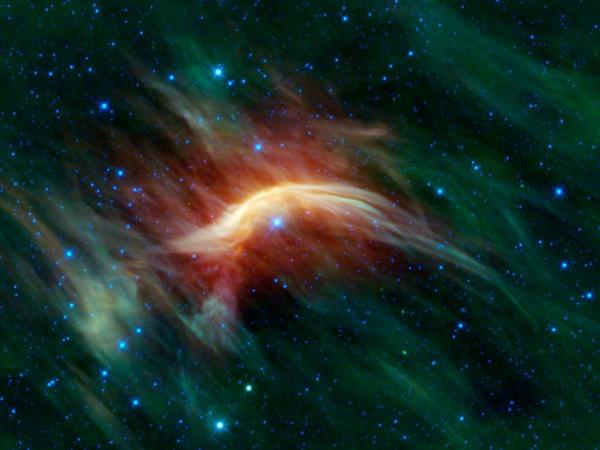


LARAMIE — In the last year, astronomers from the University of Wyoming have discovered roughly 100 of the fastest-moving stars in the Milky Way galaxy. They used images from NASA’s Spitzer Space Telescope and Wide-field Infrared Survey Explorer (WISE), and the Wyoming Infrared Observatory (WIRO) on Jelm Mountain near Laramie.
When some swift, massive stars — moving at speeds faster than 50,000 miles an hour — plow through space, they can cause material to stack up in front of them in the same way that water piles up ahead of a ship or a supersonic plane creates a shockwave in front of it. Called bow shocks, these dramatic arc-shaped features in space are helping researchers to uncover massive, so-called runaway stars.
“Some stars get the boot when their companion star explodes in a supernova, and others can get kicked out of crowded star clusters,” says William Chick, a UW doctoral student in physics, who presented his team’s new results Jan. 5 at the 227th American Astronomical Society meeting in Kissimmee, Fla. “The gravitational boost increases a star’s speed relative to other stars.”
“These are a previously uncatalogued collection of fascinating stars,” says Chip Kobulnicky, a UW professor in the Department of Physics and Astronomy, who supervises Chick. “These are hot, massive stars that are moving through interstellar space at supersonic speed.”
Kobulnicky says they use the bow shocks to locate these massive and/or runaway stars.
“The bow shocks are new laboratories for studying massive stars and answering questions about the fate and evolution of these stars,” he says.
The Earth’s sun moves around the Milky Way at a moderate pace, but it is not clear whether it creates a bow shock. By comparison, a massive star with a stunning bow shock, called Zeta Ophiuchi (or Zeta Oph), is traveling around the galaxy faster than the sun, at 54,000 mph (24 kilometers per second) relative to its surroundings. Zeta Oph’s bow shock can be seen below.

“It’s amazing that you can get something that big moving faster than 50,000 miles an hour,” Chick says. “It’s quite an event.”
Both the speed of stars moving through space and their mass contribute to the size and shapes of bow shocks. The more massive a star, the more material it sheds in high-speed winds. Zeta Oph, which is about 20 times as massive as the Earth’s sun, has supersonic winds that slam into the material in front of it.
When a massive star with fierce winds like Zeta Oph zips through space, it forms a pile-up of material that glows. This arc-shaped material heats up and shines with infrared light that is assigned the color red in the many pictures of bow shocks captured by Spitzer and WISE.
| William Chick, a UW doctoral student in physics, gives his presentation about fast-moving stars and bow shocks, materials that form in front of them, during the recent 227th American Astronomical Society meeting in Kissimmee, Fla. Chick led a team of UW researchers who discovered roughly 100 of the fastest-moving stars in the Milky Way galaxy. (Phil McCarten/American Astronomical Society Photo) |