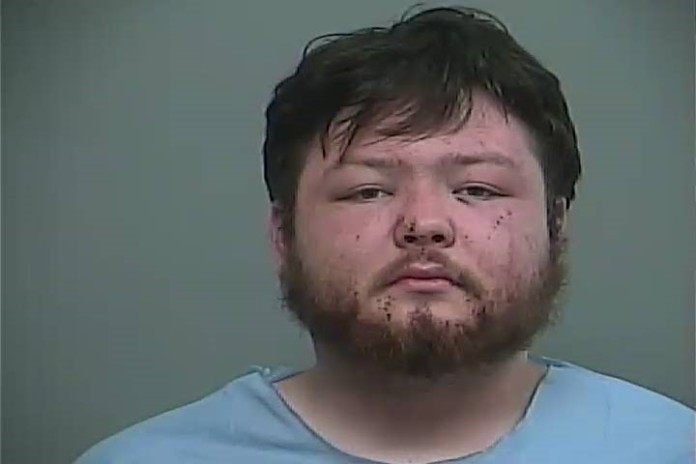

SWEETWATER COUNTY — The state rested their case today after the jury heard prosecution witness phase testimony in the murder trial of Bradley Ross Fairbourn.
Fairbourn is accused of the early morning murder of 29-year-old Naisha Rae Story and the attempted murder of Linda Mara Natlia Arce which allegedly occurred on June 23, 2016, at the Quality Inn in Rock Springs.
A single witness at the center of the case gave testimony that took most of today’s court time to complete.
Cpl. Amanda Salazar of the Rock Springs Police Department was the Lead Investigator for the case.
She said that witness accounts, along with readily available physical evidence such as blood stains, and Fairbourn’s changing accounts of the night drew her attention. She explained that the initial evidence obtained was sufficient to establish probable cause to arrest Fairbourn for the attack.
Salazar defended her investigation when the defense asked if tunnel vision had made Fairbourn the only suspect being looked into by investigators.
She said that her mind was not one-hundred-percent made up about Fairbourn’s guilt until the DNA evidence came back from the lab and the identity of the owner of a second cell phone, which was allegedly found in the defendant’s pants, was discovered.
The officer who first made contact with Fairbourn reported finding two phones on him.
Initially, the second phone sat in an evidence bag. Eventually, the connection was made between the victim and the phone.
The phone belonged to Naisha Rae Story.
Prosecutors say that Fairbourn snatched the phone to cover his tracks as part of an alleged blitz attack on the occupants of the motel room. Story’s phone was allegedly used to conduct business with Fairbourn.
Salazar explained that Fairbourn’s initial statement about an unprovoked attack by Christopher Crayton fell apart under closer examination. Details of Fairbourn’s account, which the jury heard in police interviews, such as using a crosswalk on Sunset Blvd and a non-existent traffic light were obvious fabrications.
Fairbourn admitted to lying and was heard admitting to contacting the women via messenger to arrange a paid meeting. He has denied committing the attack, saying he forgot he had no money and left.
He was also captured on video walking by the adjacent building to Smyth Printing where the knife was found.
Acre and Story were offering their services as escorts on backpage.com. Prosecutors say that an ad they placed drew Fairbourn to the motel in search of easy prey, possibly for a thrill-killing. Prosecutors concede the truth of Fairbourn’s alleged motive is known only to himself.
Crayton is the boyfriend of Linda Mara Natlia Arce. Crayton and Story’s boyfriend were staying at a nearby hotel. Crayton rushed to the Quality Inn when Acre called him saying she had been stabbed.
The defense’s questioning of Salazar and others involved in the investigation has pointed towards a theory that the two victims stabbed each other in an argument after Fairbourn visited without any money to pay for their services. As part of this theory, Crayton and Arce threw the knife on the roof on Smyth Printing when Crayton picked up a badly wounded Arce on Sunset Blvd and dropped her off at the hotel office. An alternative theory the defense has alluded to is that Crayton simply stabbed the two women before beating Fairbourn.
The defense theory tries to go around the DNA and blood evidence by saying the lab results are due to contamination from lax forensic safeguards among investigators. In addition to contamination from hospital interactions between the victims and the defendant compounded by potential lab errors that allegedly could have taken place.
The selective nature of evidence tested at the Wyoming State Crime Lab was also brought up.
The lab serves the entire state, prosecution, and defense and has limited resources.
Salazar testified that she worked with the County Attorney to prioritize the hundreds of pieces of evidence collected in the case for testing.
The defense has questioned if the RSPD has done their due diligence to test evidence that could point away from their suspect. The defense pointed out that the police have access to outside labs.
The defense presented expert witness Dr. Greg Hampikian during what would normally be the prosecution’s witness phase.
Hampikian had a scheduling conflict, additionally, expert witnesses from the Wyoming State Crime Lab were available that day to hear his testimony and offer an immediate reply.
He testified that the Wyoming State Crime Lab’s paperwork indicates a sample of the defendant’s DNA was present during testing of evidence. He called it “extremely sloppy work” but could offer no opinion on whether any of the samples of DNA, in this case, were contaminated.
He explained that by never having reference samples of a defendant’s DNA present in a lab before the amplification process takes place the chance of lab error is greatly minimized.
Hampikian said that trace amounts of DNA from contamination are impossible to distinguish from legitimate evidence after the amplification portion of DNA testing is conducted.
Defense Theory
Salazar said that she didn’t think the defense theory that the two victims stabbed each other was credible because both victims had similar defensive wounds.
The nature of the injuries inflicted on both of the victims was consistent with a larger, much stronger attacker and both victims were of petite build, Salazar said.
Salazar said she did think either victim was likely physically capable of inflicting that level of damage on the other and the consistency of the wounds points to one attacker who enjoyed a reach, height and strength advantage over the victims.
Defense Motion
After the state rested the defense moved for a Rule 29 Judgment of Acquittal. The motion was presented after the state had rested their primary case, allowing the defense to present motions in response. The jury was not present for the portion were council discussed the defense motion.
The defense motion states that the prosecution has not established premeditation necessary for a first-degree murder charge. The defense conceded under the facts presented so far a second-degree charge would be more fitting and should proceed.
The prosecution questioned the theory stating that Fairbourn’s efforts to contact the women amount to premeditation along with either carrying the whole time or returning to the room with a weapon. “Who else would open their door to him at that time of the morning?” Sweetwater County Attorney Daniel E. Erramouspe asked during the discussion of the defense motion.
The motion will be taken under consideration while the defense presents their case. The defendant is expected to take the stand.
The trial continues tomorrow.