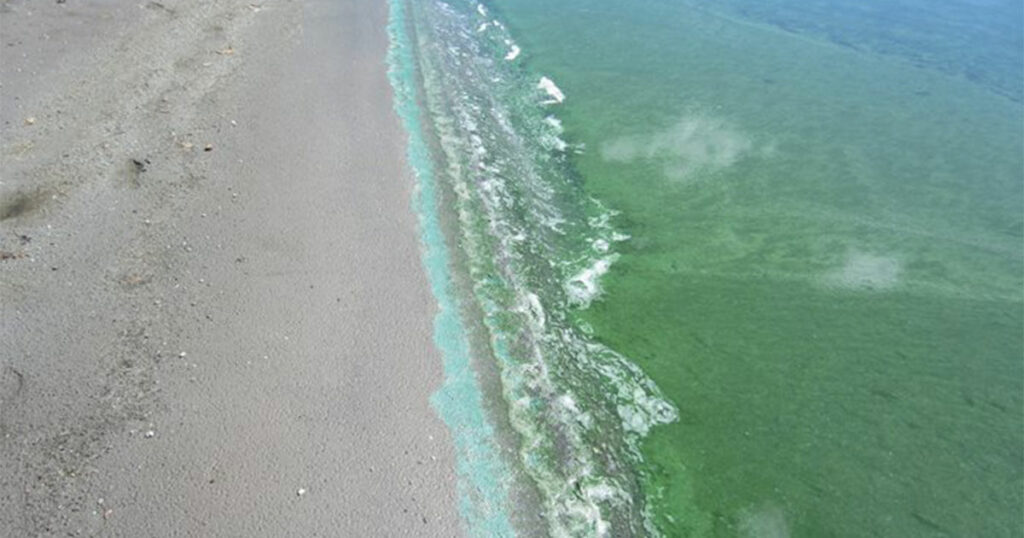

CHEYENNE — As more people head to Wyoming’s lakes and reservoirs to recreate, the Wyoming Department of Environmental Quality (DEQ), Wyoming Department of Health (WDH), Wyoming Livestock Board (WLB), Wyoming Game and Fish Department (WGFD) other partners want to remind the public to avoid and keep animals away from harmful cyanobacterial blooms (HCBs) and to report suspected blooms and bloom-related illnesses to DEQ and WDH online.
Cyanobacteria, also known as blue-green algae, can form HCBs that produce toxins and other irritants that pose a risk to human and animal health. HCBs typically develop in mid- to late-summer and can occur in flowing and non-flowing waters such as streams, rivers, lakes and reservoirs.
HCBs may be green, tan, brown or blue-green in color. HCBs may float in or on the water and look like spilled-paint, grass clippings, clumps or scums. HCBs also may be attached to aquatic plants, rocks or other material and look like films, mats or gelatinous balls.
If a bloom is present the WDH and WLB recommend the following:
- Avoid contact with water in the vicinity of the bloom, especially in areas where cyanobacteria are dense.
- Do not ingest water from the bloom. Boiling, filtration or other treatments will not remove toxins.
- Rinse fish with clean water and eat only the fillet portion.
- Avoid water spray from the bloom.
- Do not allow pets or livestock to drink water near the bloom, eat bloom material or lick fur after contact.
- If people, pets or livestock come into contact with a bloom rinse off with clean water as soon as possible.
Seek medical attention or a veterinarian if a person or animal is experiencing adverse health effects after exposure to a cyanobacterial bloom. Young children, pregnant women, people with weak immune systems and animals are especially at risk. Information on general health risks and symptoms related to a cyanobacterial bloom can be found on WDH’s webpage.
Once reported WDH may follow up on potential HCB-related illnesses, and DEQ will investigate potential blooms to determine if they are harmful. As outlined in Wyoming’s HCB Action Plan, WDH will issue advisories for waterbodies where cyanobacteria or toxins may pose a risk to people that come into contact with the water.
A Bloom Advisory is issued for a waterbody when a cyanobacteria bloom is present and cyanotoxins may be present. A Toxin Advisory is issued for a waterbody when toxin concentrations exceed recreational thresholds.
A web map of current and past advisories and answers to frequently asked questions can be found on Wyoming’s HCB website. The WDH will issue advisories for waterbodies where HCBs have been found. However, there may be additional waterbodies with cyanobacterial blooms that the WDH is not aware of.