

The Sunrise Iron Mine
By Wayne Sutherland
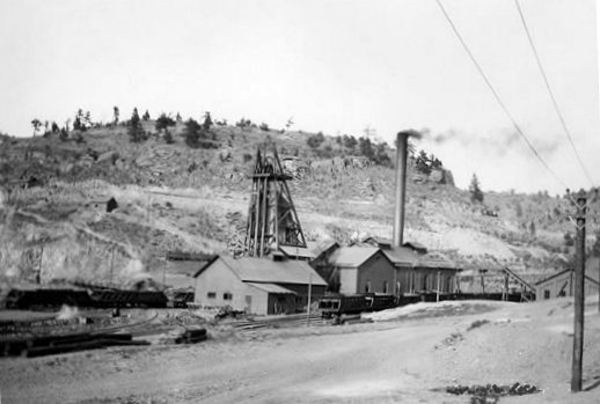
Copper ore was mined near Hartville Wyoming from 1880 until 1887, with iron production by Colorado Fuel and Iron Co. (CF&I) beginning at the Sunrise iron mine in 1898 after a ten year period of prospecting and exploration
Iron mining of the Sunrise property began in 1898–1899 and continued until 1980 when the mine closed. In 1947, the Sunrise and adjacent Chicago properties included a large open pit and underground mine. Total production during 1900–1980, from all ore bodies including the Chicago Mine, was about 42,454,000 tons (MacCannon, 2003). A current estimate for iron in the Sunrise area is around 22.2 million tonnes (24.5 million tons) or more.
Rocks cropping out in the Sunrise area in the center of the Hartville Uplift include the Precambrian Whalen Group, overlain by the Mississippian-Devonian Guernsey Formation, which is overlain by the Pennsylvanian Hartville Formation. Iron-bearing rocks occur in the Whalen Group, a thick sequence of green schists, quartzites, dolomites, micaceous schists, and graphite schists (Wilson, 1976). Hematite ore occurs in the lower part of the Good Fortune Schist which is faulted and part of a steeply east-plunging synform. Ore bodies appear localized in cross-folded zones superimposed on the synform in the thickest part of the Good Fortune Schist.
Frey (1947) described the country rock surrounding the iron ore as schist and an impure, hematite- and limonite-stained flint and interpreted the iron ore to be a replacement of the schist. Lenticular bodies of red iron ore are enclosed by schist, immediately above the uppermost limestone of the older Precambrian rocks; a thin layer of iron-stained, siliceous schist separates the iron ore from the limestone. Frey (1947) described two varieties of iron ore: fine-grained, red, generally schistose, and soft, referred to as “paint ore” or ochre, and fine-grained, dark bluish-gray, hard, compact ore with a smooth fracture, referred to as “blue ore,” which is the more valuable of the two. The “paint ore” has a deep red hue, is somewhat greasy to the touch, and leaves a rusty, metallic stain on contact. The ochre contains 57 percent Fe2O3, while the “blue ore,” is a dense, bluish-black hematite with a rusty surface that yields about 89 percent Fe2O3.
The Hartville uplift hosts a wide variety of chalcedony in sedimentary rocks and in some veins. The Guernsey Limestone (Devonian-Mississippian) is a source of many agates and jaspers in colors that include red, purple, blue, brown, and yellow, along with moss agate, dendritic agate stalactitic agate, and youngite agate.