
GREEN RIVER — The drawdown at the Flaming Gorge Reservoir may have impacts on the fisheries and fishing at the gorge as up to 1 million acre-feet of water could be drained to support Lake Powell.
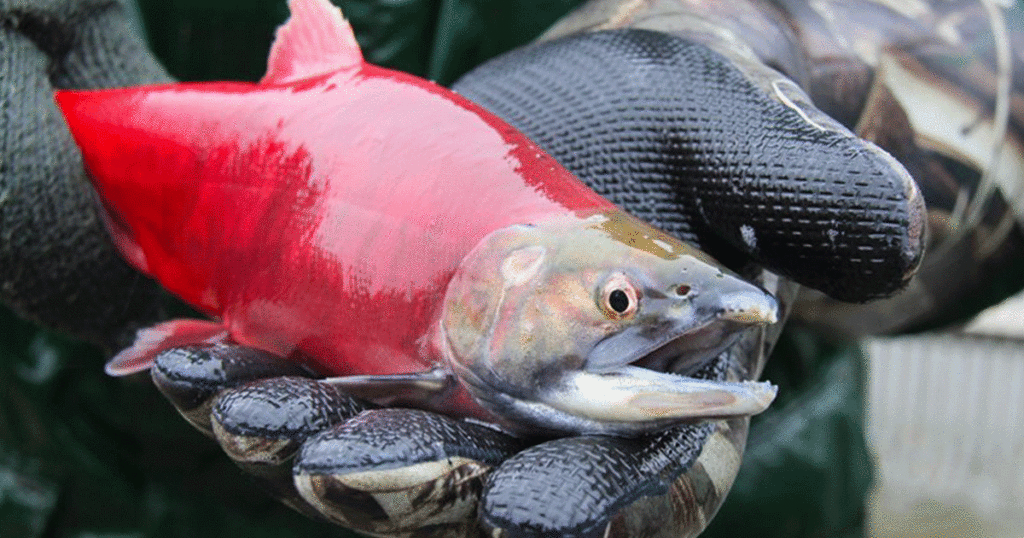
John Walrath, the regional fisheries supervisor for the Wyoming Game and Fish Department in Green River, said the biggest concern is an impact on kokanee salmon. He said the change in water elevation could impact kokanee egg and fry loss in spawning habitats that would be drained. Kokanee are a valued sport fish in the gorge and Walrath said they also serve as a “primary forage base” for the gorge’s trophy lake trout population.
“Natural kokanee reproduction is especially important at Flaming Gorge,” Walrath said. “Prior research has shown that naturally-spawned kokanee can contribute roughly 40-80% of the kokanee year class in the reservoir, depending on the year.”
Kokanee begin spawning in October and their eggs remain in the gravel until April when the fry emerge. Walrath said projections suggest the gorge could decline to an elevation of 6,006 feet by October, in time for the spawning season to start. That elevation is one of the lowest the gorge has had since it was filled. He said the gravel at that elevation may contain higher amounts of fine sediment, creating poorer-quality spawning habitat.
“As a result, kokanee may be forced to spawn in shallower areas or in habitat with poorer egg survival,” he said.
Walrath said research has shown that reservoir drawdowns beyond 10 feet can significantly impact kokanee spawning, even when deeper spawning habitat is available. Walrath said stocking helps maintain populations during years where natural spawning struggles, but stocking kokanee isn’t expected to fully sustain the fishery if their natural reproduction is consistently reduced.
He said the timing of additional fall and winter releases is important because kokanee spawn within a narrow band of suitable gravel and releases dropping below that band may cause a substantial loss for the year.
“In a worst-case scenario, if only a limited band of clean spawning gravel is available and the reservoir drops through that band during incubation, the loss of natural kokanee production for that year could be substantial,” he said.
Walrath said the broader fish community could be impacted as well, as reducing the habitat and increasing predator-prey overlap may put additional pressure on kokanee and other forage fish, saying that would impact other sport fish.
“Because Flaming Gorge is managed as a complex, multi-species fishery, impacts to kokanee and forage availability can ripple through the reservoir and affect predator growth, fish condition, and angler opportunity,” Walrath said.
Wyoming Access Impacts
Walrath said boating access on the Wyoming side of the gorge could be impacted if low reservoir elevations continue, saying a worst-case scenario would leave Buckboard as the only consistently available public boat ramp.
“Other Wyoming access points are more vulnerable at lower reservoir elevations. Brinegar faces significant sediment issues and would likely become unusable at approximately 6,000 feet. The Anvil Draw ramp is expected to become unusable somewhere between approximately 6,013 and 6,015 feet,” he said.
At Anvil Draw, Walrath said the ramp could be unusable as early as June under current projections. By next spring, he said water levels could be low enough where Firehole would function like a river corridor and “substantially limit traditional boating access.”
“Maintaining boating access as reservoir elevations decline will require substantial ramp maintenance, sediment management, and infrastructure improvements. Those efforts can be costly and would need to happen quickly if access is to be preserved under the projected drawdown scenario,” he said.
He said the WGFD and U.S. Forest Service are working on plans to widen and extend Wyoming boat ramps. Their goal is to have construction beginning during the fall or winter of 2027 or spring 2028.
“Low reservoir elevations create access challenges for boaters, but they also provide a more cost-effective opportunity to complete certain construction activities on dry ground rather than underwater,” Walrath said. “The more construction that can occur on dryland, the further sportsmen’s and grant funds can go to improve access across all major boat ramps in Wyoming for future low water elevations, lessening future impacts to recreationalists on Flaming Gorge Reservoir.”
Some Benefits to Lower Water Elevations
While there are a number of impacts that could occur to fisheries and boating access, there are some potential benefits as well. Walrath said newly-exposed shoreline can allow vegetation to take root and grow. If areas develop good vegetation and later gets covered by a strong runoff, it could create flooded habitat for carp, white sucker and Utah chub. Increased prey fish would then create additional food for predator fish, including sport species, and increase growth, condition, and overall fish quality.
“That benefit, however, depends heavily on timing and future water conditions,” Walrath said. “Exposed vegetation only helps the fishery if it grows successfully and is later flooded, when prey fish can use it. If water levels remain low for an extended period, or if the reservoir does not rebound enough to inundate those areas, the benefit may be limited.”
He said the drawdown creates both risks and opportunities for the gorge, with some of the benefits coming from new shoreline vegetation, which could give a short-term boost to the sport fishery.