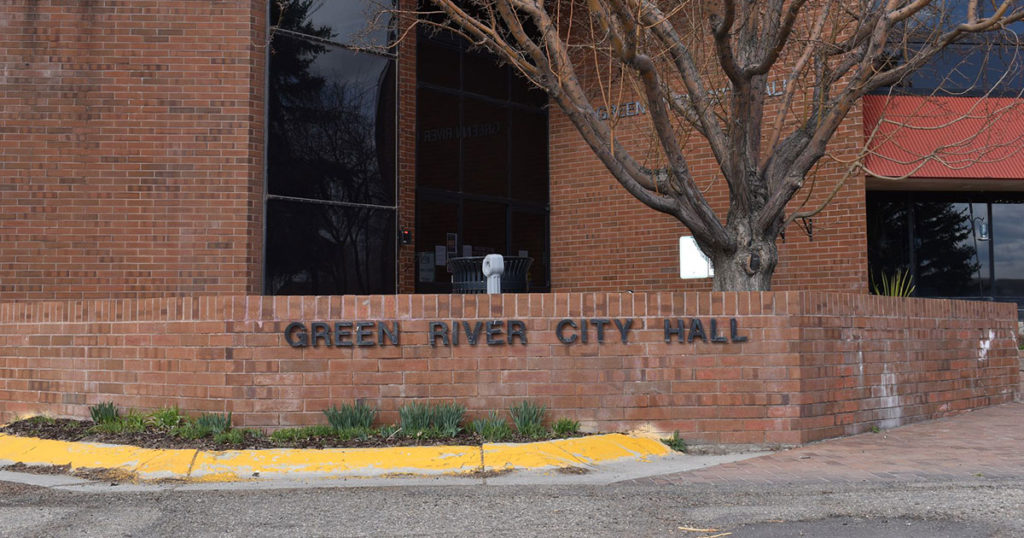

GREEN RIVER — A proposed change to how Green River calculates sewer rates drew sharp disagreement among City Council members Tuesday night.
The ordinance before the council on first reading would not raise sewer rates but would change the formula used to calculate each customer’s monthly average, shifting from the current six-month winter average to a shorter window. City Finance Director Chris Meats presented the proposal, noting it was informed by professional rate studies the city has commissioned.
What the Data Shows
City data shows that of roughly 4,000 recurring customer accounts, about 2,600 saw increased usage between April 2025 and April 2026, and approximately 920 of those accounts saw bill increases greater than 20%. Staff calculated the typical bill change fell between $10 and $20, though individual outliers were significantly higher and lower.
Staff noted that accounts with unusually large increases could be flagged for individual review through the city’s existing utility review process, recommending a $15 threshold for that review. The analysis also comes on the heels of an 18% rate increase that took effect July 1 of last year.
The Core Disagreement
Councilman Ron Williams argued the current system is fundamentally unfair because customers are being billed for sewer use based on water consumption that never enters the sewer system.
“When that water is not going down the sewer, it’s going on the grass,” Williams said. “They did not get a service. It did not go down the sewer, so how can you bill something for that?”
Williams compared it to paying a lawn crew that never showed up.
“It’s like having a guy cut my grass, but he didn’t cut the grass, and he’s still billing me for it,” he said.
He cited his own daughter receiving a $98 sewer bill and said he knew of roughly ten other customers facing bills in the $90 to $144 range during the season. Williams said those high spring bills should be thrown out of any averaging calculation entirely.
Williams also pushed back on language in the proposed ordinance that would allow customers to opt into an alternative billing method, arguing most residents would never know the option exists.
“I don’t like that terminology, ‘may elect,'” Williams said. “I think that should be cut. Just say, this is the way it is.”
Councilman Gary Kilpack firmly disagreed, arguing the data does not support an overhaul. Of 4,700 customer accounts, only 30 had submitted legitimate complaints about sewer bills over the past seven years.
“That is .006%. Name it as it is,” Kilpack said. “It’s working great the way it is.”
Kilpack said he had personally spoken with customers paying $180 a month who understood and accepted how the system worked. He also cautioned against locking a specific averaging window into ordinance, warning that any future adjustment would require going through the full ordinance process again.
“I don’t even think we need this,” Kilpack said. “I think it’s silly.”
Williams countered that the council should simply follow the professional studies it had already paid for.
“We paid for two studies and they recommended this way. They must know something,” he said.
The Cost of Accuracy
Meats acknowledged the averaging method is imperfect but said the alternatives were prohibitively expensive. Installing individual sewer meters would cost well north of $1 million and would require residents to add separate irrigation meters to their properties.
I can be accurate or I can be close, accurate is a lot of money, a lot of resources.
Green River Finance Director Chris Meats
He also noted that the sewer system operates as an enterprise fund that must break even, meaning savings passed on to one customer are absorbed by others.
“If you’re gonna save one neighbor a couple bucks, the next neighbor is gonna pay for it,” Meats said.
What Comes Next
The council took no final action Tuesday, as the item was on first reading. Rust noted the discussion would be more deliberative than a typical first reading, with more analysis expected at future meetings before the ordinance moves forward.