
LARAMIE — Help is available for residents concerned about their landscape plants as temperature swings and a dry, windy winter takes their toll.
The University of Wyoming Extension Office published an online brief aimed at assisting gardeners. They’re also encouraged to contact their local extension offices with any questions or concerns. Sweetwater County’s extension office is at Western Wyoming Community College, in Room 1336 and Rooms 1339-1342. It’s phone number is 307-352-6775.
“We’ve had unusually warm and dry weather in many parts of Wyoming this winter,” Jennifer Thompson, UW Extension horticulture specialist and author of the brief said. “If this trend continues and brings with it our typical western region yo-yoing temperatures—warmer spells followed by deep freeze events—we are likely to see a variety of effects on plants as spring and summer roll around.”
Cold damage can affect the flowers, leaves, and woody stems and branches of trees, shrubs and flowering plants. Effects vary depending on species and conditions, but certain types of damage are common when mild winter weather is followed by a cold snap.
Newly planted or thin-skinned trees can be at risk of trunk damage caused by sunscald. As sun warms a tree’s bark, its cells become more active; as the temperature drops sharply at night or during a cold spell, these active cells can freeze, causing tissue damage on the side of the tree facing the sun.
Sunscald can be fatal in some cases, but prevention measures exist and trees often successfully partition off this type of damage if it is not too severe.
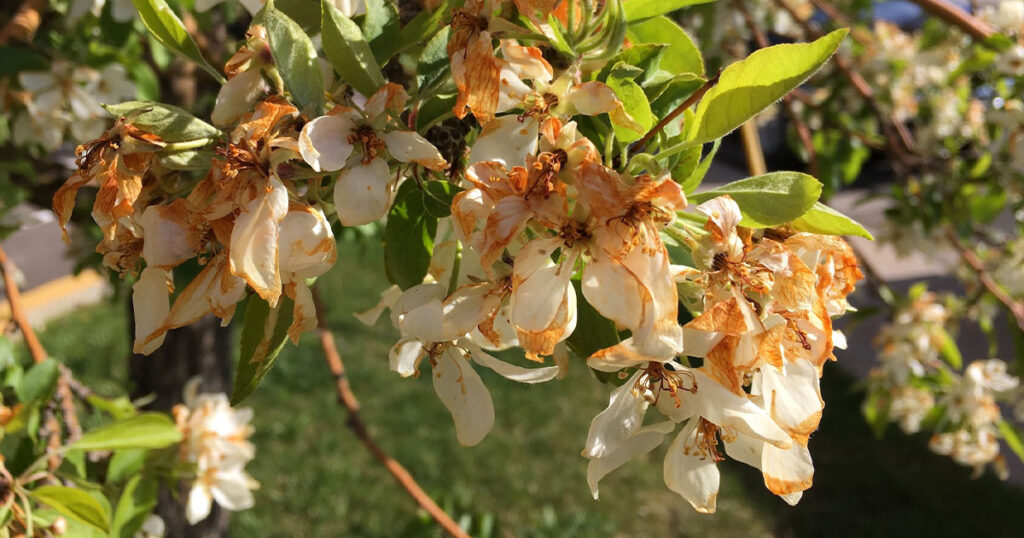
Especially in years with severe temperature swings, it’s not unusual for flowering fruit trees to suffer cold damage. This often results in little to no fruit set during the upcoming growing season, but doesn’t hinder future fruit production.
Many healthy perennial plants that sustain early cold damage will outgrow it as the season progresses. Some spring bulbs that emerge earlier than usual may remain unscathed, in some cases freezing at night and defrosting in the morning without ill effects.
If bulb flowers and foliage are partially damaged by the cold, it is not recommended to remove them. Instead, gardeners are advised to leave them in place until they naturally die back for the season.
If a tree appears to have suffered cold damage to branches or stems, it is best to monitor its response rather than immediately reaching for the pruning shears. Trees and shrubs often put out a new flush of leaves and have reserve buds that begin growing if primary buds are damaged.
In many cases, landscape plants can recover from cold damage, especially if they receive plenty of water and nutrients during the recovery period.
“Whether we get some untimely deep freezes after plants have come out of dormancy this year, or the next, or the one after that, we hope that this article will help you determine what has happened and what steps you can take to help plants recover,” Thompson concludes.
To read the full article, which also offers tips on caring for trees and shrubs affected by winter desiccation, click here.