
The Marine Corps has standards and requirements that are common among all of its members, but those who earn the title Marine are anything but common.
Unlike the other branches of the military, a new recruit is not considered a Marine or a member of the Marine Corps until he or she has successfully completed boot camp. Getting to that point is not easy, considering that 90% of males are not eligible for the Marine Corps.

The Complete Individual
While a large portion of training is dedicated to physical exercises to build a recruit’s physical stamina, other principles are taught that are just as important.
Recruits receive physical, mental, and moral training. A Marine’s character is based on the Corps’ values — honor, courage and commitment. A Marine is not just a basically trained, morally conscious individual, but also a better American citizen who will return to society following his or her service to our country.
While I was with the Marines, I heard these ideas repeated by Marines of all ranks.

Hand to Hand Combat Training
Part of a recruit’s training is hand to hand combat. For 46 years, Marine Corps’ hand to hand combat training was anything-goes-sparing. After many injuries over the years, someone realized this was not effective. Boxing was then instituted for about 5 years; however, someone yet again realized boxing was not very useful on the battlefield if the enemy has a knife and all you have are your fists.
Taking the experiences of the previous two attempts to prepare Marines for battle, the Marine Corps gathered instructors from several different martial arts fields and created their own fighting style. This newest implementation has lasted for 14 years and is what current recruits learn during training.

Second Nature
To be a good Marine, many habits have to become second nature. To achieve this recruit training has an obstacle course or test for anything you can think of.
A basic overall schedule of their training includes:
- Week 2 – Daily Discipline
- Week 3 – The Bayonet Assault Course
- Week 4 – Pugil Sticks Fighting
- Week 5 – Martial Arts Program
- Week 6 – Rappeling
- Week 7 – Grass Week/Rifle Training
- Week 8 – Firing Week
- Week 9 – Confidence Course
- Week 10 – Day Movement Exercises
The Crucible
Week 11 is centered around the Crucible. In 1966, the first company of recruits passed The Crucible. Since then, it has been the final test that signifies a recruit making the step from Recruit to Marine.
The Crucible is a 54 event that tests every skill a recruit has learned and every value instilled. During that time a recruit receives three MRIs that must be rationed over the course of the event and will get only four hours of sleep
Part of the Crucible is a team work exercise called “12 Stalls.” During this event, recruits in groups of 10-12 complete specific tasks as teams in a specific time period. At each stall, a different recruit must take the lead of the group and figure out how to work through a task.
Among other things, the Crucible also includes over 45 miles of marching.
The Globe and Anchor
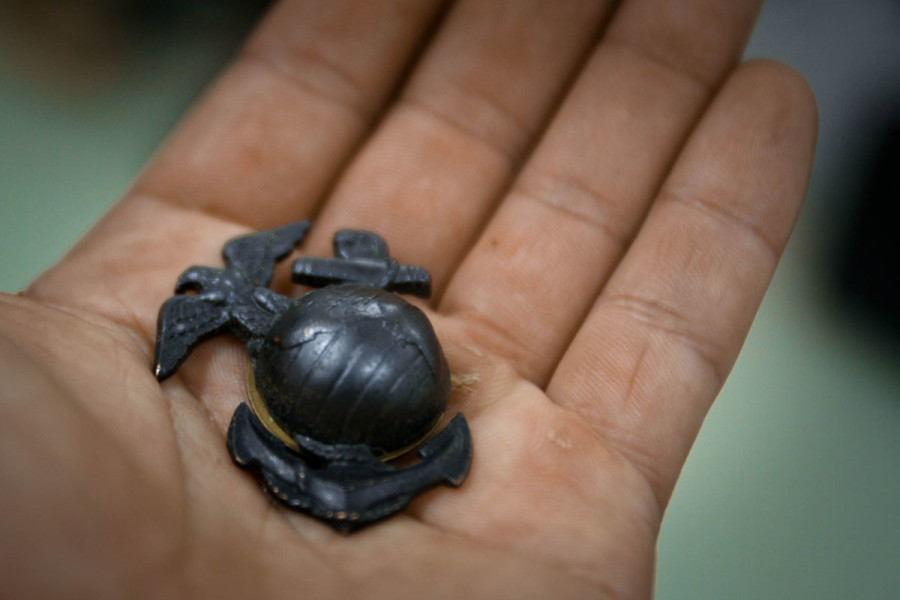
After all tasks and tests have been completed satisfactorily, and a recruit has shown that he or she has what it takes to join the ranks of “the few and the proud,” the globe and anchor is pressed into their palm letting them know they are now a Marine. This event can be emotional for many new Marines.
After my week with the Marines, it is obvious the Marine Corps is not for everyone; however, I would have to agree with a recruit I talked with while I was there who said, “After [recruit training] I feel like [a Marine] will be able to do anything.”