Como Bluff, An Anticline
By Martin Larsen
COMO BLUFF — Within the Morrison Formation of the anticline were well-preserved Dinosaur fossils. Many of the dinosaur bones discovered at Como Bluff were by Palentologist Othniel Charles Marsh and Edward Drinker Cope. With the rush discover and publish – all with fame in mind – a bitter dispute erupted between Marsh and Cope for the quarries, which lead to academic sabotage.
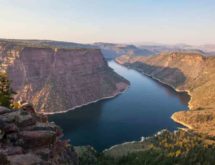
The Como Bluff anticline is a west-plunging, asymmetric fold that extends from the western slopes of the north-trending Laramie Range into the east-central portion of the Laramie Basin. Como Bluff, an anticline with the Morrison formation contains shales and sandstones deposited by rivers about 180 million years ago when dinosaurs roamed the area.
The Como Bluffs axis marks the geomorphic boundary between the Laramie Basin to the south and Shirley Basin to the north. Highway 30 cuts across the plunging nose of the anticline. Formations dating from the Cretaceous, Jurassic, and Triassic periods are exposed in the face of the bluff and in the core of the anticline.
The south flank of the anticline is capped with south-dipping Muddy Sandstone and the conglomerate sandstones of the Cloverly Formation. The Cretaceous Cloverly Formation forms a prominent hogback, known as Como Bluff. The Morrison Formation, where a large number of the dinosaur bones were found, is exposed along the northward-facing, steep slope of the ridge. Other formations include the Sundance and Jelm Formations, which are exposed in the lower portions of the ridge, and the Chugwater Formation, which is exposed in the core of the anticline.
The northwest limb of the anticline is bounded by the North Como fault; a high-angle reverse fault. The exposed beds on the north flank are nearly vertical with some beds overturned in places. The resident bed of the Muddy Sandstone forms a northeastward-trending, well defined minor hogback that lies at a lower elevation than Como Ridge.
The low-dipping Jurassic Morrison formation on the south flank of the anticline promoted great excavation opportunities by paleontologists. This-world famous formation consists of shales, thin sandstones, limestone conglomerates, and freshwater limestones. The exposure of this formation has yielded many vertebrate fossil remains. Como Bluff has been called a “dinosaur Graveyard.” In the late 1870s, large numbers of dinosaur bones and well-preserved skeletons were discovered at Como Bluffs.