
ROCK SPRINGS — Patients requiring the use of Memorial Hospital of Sweetwater County’s nuclear medicine scanner have a new machine for their procedures.
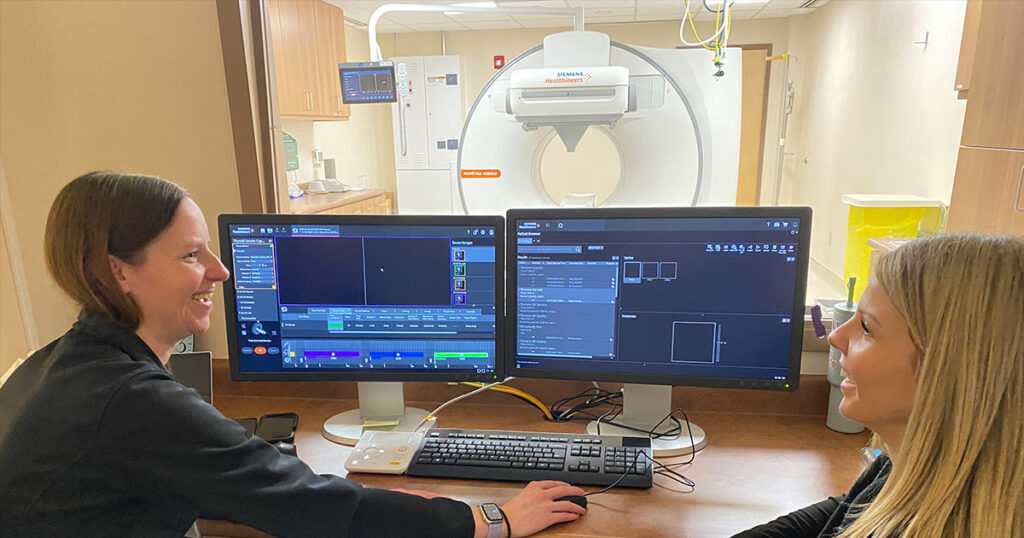
Training on the new nuclear medicine/CT scanner was completed earlier this month. MHSC Nuclear Medicine Tech Shelynn Edwards worked with Siemens trainer Erin Rierieck to learn the ins and out of the new system. Kayla Rohrich, MHSC x-ray tech, helped demonstrate the patient procedure.
“MHSC has held a nuclear medicine license since at least 1977,” MHSC Imaging Director Traci Soller said. “This machine replaces one that was at the end of its life.”
Nuclear medicine is a specialty using safe and painless techniques to both image the body and treat disease. Nuclear imaging consists of examinations in which a small amount of radioactive material is injected or swallowed and travels to a target organ that can then be studied. Specially designed cameras allow doctors to track the paths and locations of these radiotracers/radiopharmaceuticals within living organisms. These exams are especially valuable as they can show how the organ or system is functioning.
Nuclear medicine can detect blood flow problems in the lungs, brain, or heart; bone diseases and trauma; brain diseases such as Alzheimer’s disease, epilepsy, or dementia; cancer that has spread or returned after treatment; coronary artery disease and blocked blood vessels; gallbladder inflammation; and gastroparesis.
“The machine itself is quite a bit more automated,” Edwards said. “It can do auto quality control in the middle of the night, which is a huge time saver.
“Quality control for the old scanner would take me approximately five hours each week,” she said. “Now, I only have to worry about doing daily quality control, which takes less than 15 minutes at the start of the day. We are required to do daily, weekly, monthly, quarterly, and yearly quality control to ensure the machine is functioning properly without any defects.”
“As for the CT scanner, the biggest difference is that it can be utilized as a 64-slice scanner, whereas our last machine was only a 16-slice scanner,” Edwards said. “This allows for faster scan times, reduced radiation exposure, and higher image quality.”