
ROCK SPRINGS — While they have different approaches to state issues, the candidates seeking election to House District 48 do agree that something has to change in Cheyenne.
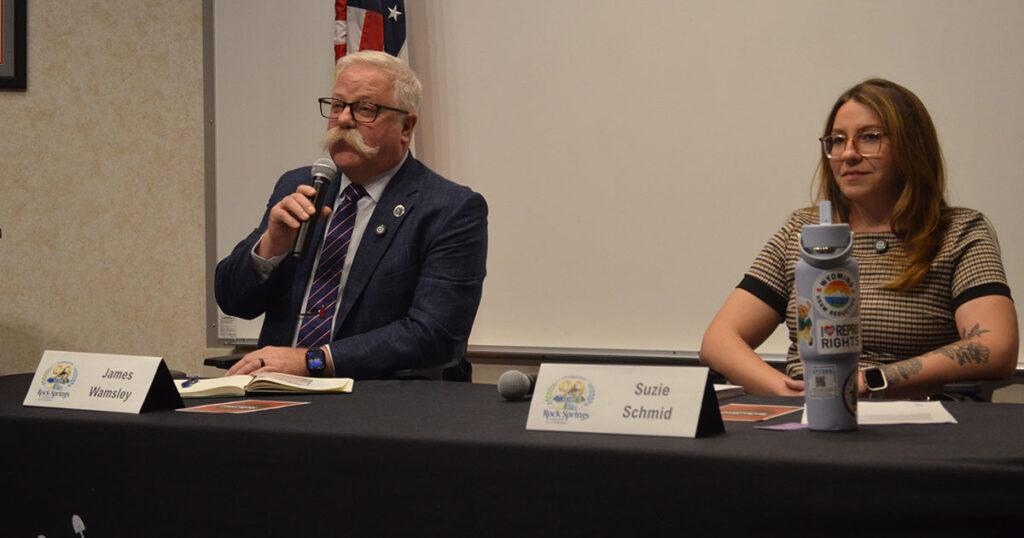
Democrat Susan Schmid and Republican Jim Wamsley spoke to residents during a legislative debate hosted by the Rock Springs Chamber of Commerce Oct. 22.
Schmid is a political organizer and serves as the vice chairperson of the Sweetwater County Democratic Party. She earned the nomination after launching a write-in campaign for the Primary Election in August.
“I think that this is an opportunity to show the folks that have been in charge for a really long time that we’re starting to draw the line,” she said. “I was born and raised here, but these problems have been around longer than I’ve been alive.”
Schmid said when people talk about problems related to affordability, they have to take those discussions and apply reform to the state’s healthcare system and diversify Wyoming’s economy in a way that improves accessibility to healthcare, which she says will help in recruiting doctors.
She said public lands need to remain accessible, with people remaining good stewards of that land to protect it.
“I’m running because I was born and raised here, and I see the way that our city is changing to no longer be representative of the folks that live here,” Schmid said.
Her opponent, Rock Springs Fire Chief Jim Wamsley, received the nomination after defeating Rep. Darin McCann in the August primary in an election that saw a majority of Freedom Caucus members and supporters voted out of their legislative seats. Wamsley wants to return political discourse to a point when people could discuss issues and have constructive dialogue.
“I think we have missed out in recent years by not sitting down, examining (multiple) opinions, taking that dialog to the Legislature, and making sure that we’re looking at all sides of a problem,” Wamsley said.
While discussing water the two agree Wyoming needs to use the water it is legally allotted. Schmid said the state should consider better containers for the water allotment Wyoming has under the Colorado River Compact, while ensuring it is using its allotment and treating it as a leverage tool to ensure the state’s residents receive prioritized access. Wamsley spoke about the book “Where the Bluebird Sings to the Lemonade Springs,” which he said highlights the arid west and the limitations in the region’s water supply. He also believes Wyoming has to use its allotment and preserve its rights under the agreement. Wamsley said the state has to invest in itself to ensure that water allotment is used, while being critical of uses downstream such as the Bellagio fountains in Las Vegas.
With economic diversification, both candidates see education being a major factor in making sure that happens. Wamsley said the state has to ensure the community colleges and school districts are adequately funded. Making sure southwest Wyoming has the power generation capability is part of the solution, saying the state shouldn’t build everything but ensure the road is paved to an economic “Field of Dreams.” However, he said other communities are investing heavily in attracting businesses to them.
“The fact is, there are other communities and other locales out there that are spending that money already to attract that business,” he said. “They’re building that field of dreams. We need to do that as well.”
Schmid said the best way to create economic diversification is to start with what Wyoming already excels at.
“If resources is where we really shine, there is zero reason why the University of Wyoming shouldn’t be leading the way on research for the entire energy industry, whether that’s carbon capture, nuclear technology, or further streams,” she said.
She said that philosophy should also extend to the community colleges to help build a steady stream of employees to handle the jobs those industries demand. Schmid believes better opportunities will feed small businesses because people making living wages will be able to support those businesses.
On tax relief, Schmid said the state doesn’t have to rely exclusively on minerals for state revenue. She said more revenue could be generated through corporate taxes and ensuring they pay their fair share, saying Wyoming doesn’t have to sell itself cheap to corporations. She said the state needs to reflect what Wyomingites care about.
“If we care about kids and want them to stay here and have families, then maybe we should prioritize healthcare and having a landscape that’s hospitable for them,” she said.
Schmid said people are able to get some tax relief, but reiterated that funding to communities, education, and infrastructure should be prioritized, saying Wyoming should fund its state government for it to work.
Wamsley said tax relief is an option, though he believes enough has been done already. He said mineral revenue is declining and lawmakers need to work out how they will deal with that problem. He returned to his earlier statements about the state investing in itself but said it has depended on oil and gas too long.
“Coal will always be here. Trona will always be here, and I don’t think they’re ever going away,” Wamsley said. “But in their current form, I don’t think they will always contribute to our economy the way that they always have.”
Wamsley said there will be less sales and use tax generated from trona if sales of the ore decline and believes the state needs to consider what the most important services it provides to residents are.