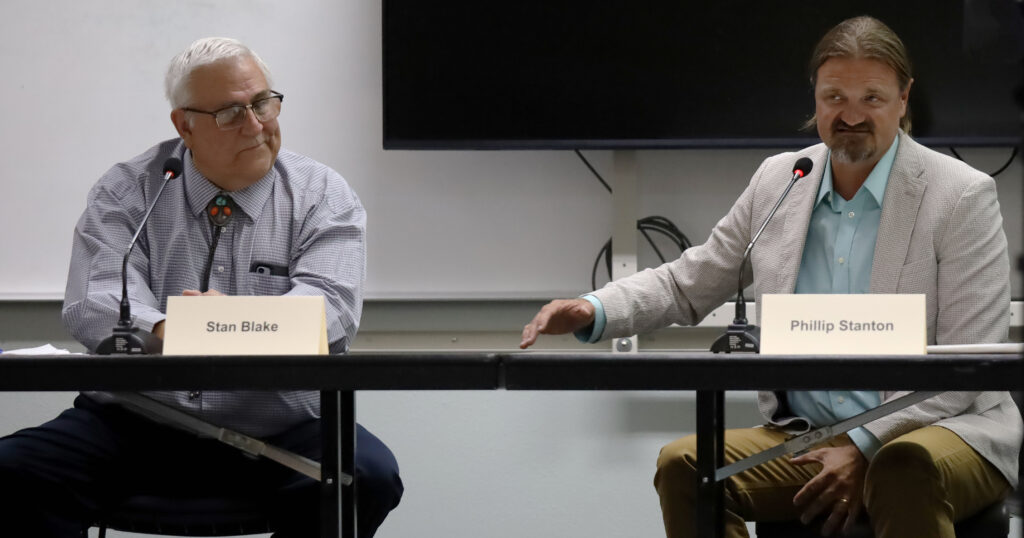

GREEN RIVER — Green River mayoral candidates Stan Blake and Phillip Stanton disagreed on the future of the city administrator position and how to pay for aging infrastructure during a political forum Oct. 7 at Western Wyoming Green River campus.
Moderator Rebecca Rood asked what direction the mayor and council should take with the management of the city, since the current city administrator’s contract ends July 1, 2027.
Stanton said Green River has had a city administrator since 1985 and that the earlier strong mayor and council system worked for the city. He said the position no longer makes sense to him and that City Hall has no clear lines of responsibility. While he would just be one of seven voices on the council, he said he would listen to everyone to see what is going to work.
“I heard earlier that getting rid of the city administrator is going to be hard, well I would expect so,” Stanton said. “Anything worth doing is going to be hard.”
Blake said it would be up to the council whether to renew the city administrator’s contract or get a search for a new one. He said running a city requires knowledge of Title 15 and 16 of state statute and staying compliant with state and federal regulations. He said despite being in the state legislature for 14 years, he doesn’t have “that much” knowledge on what a city can and can’t do.
“I’m in favor of the city administrator the way it is right now,” Blake said. “Whether we have a new city administrator or not, that’s going to be up to the council and mayor.”
Infrastructure and Borrowing
The candidates differed most on how to fund the city’s aging infrastructure.
Blake said that Green River is going to have to go the route of getting State Loan and Investment Board Loans for infrastructure projects because the city’s revenue has dropped. He also said state loans carry low interest rates not available anywhere else.
Blake said since House Bill 107 has passed, Green River will get a more predictable stream of sales tax revenue that the city can bank on.
“Aging infrastructure needs to be solved and that’s going to be a herculean task,” Blake said.
Stanton agreed that solving the city’s infrastructure problem is going to be difficult, but differed on how to solve the problem. He said there needs to be a definitive list of every piece of infrastructure with its age, its value, and how much it’s going to cost to fix, maintain, and replace.
Stanton opposes the idea of borrowing money from SLIB for every project and wants the city to pay more of its own way. With the recent council decision not to borrow $3 million for a water tank repair, he said that now is Green Rivers’ chance to rein in the amount they are borrowing.
“We need to start fixing some of these problems with our own money,” Stanton said. “Going to the state and getting a loan for every single problem you have? That doesn’t work for me.”
Solid Waste District
Rood asked what direction the city should take with its next solid waste contract, which ends in December 2027. Both candidates said they met with Sweetwater County Solid Waste Disposal District No. 1 General Manager Dan Chetterbock and heard his plan to absorb Green River into the district.
Stanton said it is arguable whether joining would benefit that city, but it will end Wyoming Waste’s status as Green River’s sole waste disposal company. He also said that residents will pay a mill levy tax, but will not be charged for using the landfill like they currently do.
“That’s a huge step in the right direction,” he said. “It’s going to be a huge benefit to all of us as residents of Green River.”
Blake said he largely agrees with Stanton that Green River will likely end up as part of the solid waste district but has concerns about the transfer station. He voiced concerns about residents not waiting to haul loads of trash down the interstate to dispose of it at the landfill and that more trash will be dumped in the desert. He said Chetterbock told him the transfer station could possibly remain open.
“I would like to definitely look into that when the contract comes up,” Blake said. “We need to look long and hard at that.”
Sixth-Penny Tax
Both candidates agreed that the sixth-penny tax is a great tool and source of funding, but differed on how it should be used.
Stanton said the tax is absolutely beneficial, but is negative about the way the city utilizes the funds. He believes the tax isn’t intended to fix roads every year and fund infrastructure projects. He said the city should pay for routine road work and use the sixth penny for “visionary” projects, such as the recreation center’s maintenance backlog.
“I don’t think we should utilize the sixth penny money to backfill our budget for items we can’t seem to get under control,” Stanton said.
Blake said the funds are used on the worst roads in Green River and that some of the money is also used to pay down some of the loans.
“The roads in Green River, a lot of them they suck, I’ll put it like that,” Blake said.